Do you speak COVID-19? – The importance of language for effective communication across the response
Also available in French and Spanish.
Portée et efficacité de la communication sur la Coronavirus (en FR, LN, SW, NNB)
TWB et Mercy Corps ont menée cette étude qui porte sur la COVID-19 / le Coronavirus et sur les informations que le public reçoit sur ce virus. Elle vise à comprendre si les informations sur le Coronavirus sont utiles aux personnes, si elles ont accès à ces informations et si elles manquent d’informations. (Disponible […]
Language diversity in the COVID-19 pandemic
People have a right to access the information they need during the COVID-19 pandemic. Yet often that information is not available in languages and formats they understand. COVID-19 is rapidly expanding in linguistically diverse countries. Organizations supporting the response need to develop communication strategies that cater to the needs of marginalized language speakers in these […]
Words of Relief impact study of rural and urban Kenyans
Does translated health information lead to higher comprehension? We conducted a research study to examine the level of comprehension of health information when presented to Kenyans in English and translated into Swahili. You can view it our impact study of rural and urban Kenyans here. Other resources that might interest you: Words of Relief – […]
Words of Relief – Ebola crisis learning review
This learning review examines TWB’ initiative aimed at improving communication with communities during the Ebola outbreak in West Africa from November 2014 to February 2015, with examples of good practice, gaps, and suggestions for improvement. You can view it below or read and download our Ebola crisis learning review here. Other resources that might […]
Language guidance for communicating about COVID-19 in Northeast Nigeria
What Matters? Humanitarian Feedback bulletin
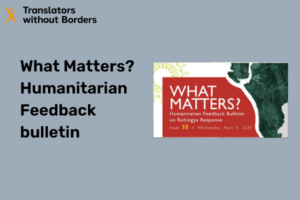
BBC Media Action, Internews, and Translators without Borders are working together to improve two-way communication between the Rohingya refugees, the host communities, and the humanitarian actors. What Matters? provides a snapshot of feedback received from affected community members, to assist sectors to better plan and implement relief activities with communities’ needs and preferences in mind. […]
Language barriers in the humanitarian response in Northeastern Nigeria – initial assessment
Discussing WASH in the Rohingya language: Building a better dialogue around water, sanitation, and hygiene (WASH) issues [Bangla]
Download or view in a new tab our Rohingya WASH language guide here.
Discussing WASH in the Rohingya language: Building a better dialogue around water, sanitation, and hygiene (WASH) issues [English]
Download or view in a new tab our Rohingya WASH language guide here.
Discussing disability in the Rohingya language
Download or view in a new tab our Rohingya disability language guide here.