View this research report in a new window here.
TWB glossary for WFP Community Engagement
The TWB glossary for WFP Community Engagement covers subject areas relevant to affected communities in a variety of contexts and includes a total of 216 terms in English, Arabic, Chewa, French, Portuguese, Sinhala, Spanish, Congolese Swahili and Tamil. Sign translations are also available in Malawian Sign Language and Sri Lanka Sign Languages (Sinhala and Tamil […]
Philippines Super Typhoon Rai (“Odette”) – Crisis language map
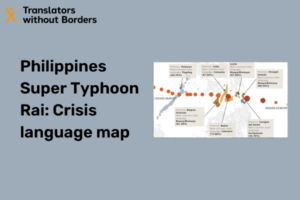
(Click here to open in a new window.) Typhoon Rai made an initial landfall in Siargao Island, province of Surigao del Norte in Caraga region, northern Mindanao on 16 December 2021. It carried gusts up to 270 km/h with maximum sustained winds of 195 km/h near the centre making it the strongest storm to make […]
Localized communication minimizes the impact of Ebola in DRC
The response to the 11th Ebola outbreak in the Democratic Republic of Congo (DRC) proved the merits of local, multilingual communication with communities. TWB’s research found significant progress compared with the response to the 10th outbreak, and to the many humanitarian emergencies that have affected DRC to date. However, our research also highlighted the need […]
In the loop: developing effective complaints and feedback mechanisms
Complaints and feedback mechanisms are an essential part of the humanitarian community’s ability to be held accountable for the assistance and protection we deliver. You can view our research brief below or here. Also is available an illustrated version created to guide you through.
Lessons still to be learned from the recent Ebola outbreaks in DRC
Complaint and feedback mechanisms: Effective communication is essential for true accountability
This report summarizes key findings and recommends actions to improve accountability in Northeast Nigeria through more effective and responsive complaint and feedback mechanisms. TWB found that humanitarian organizations are largely prioritizing verbal communication in a context of low literacy, particularly among women and older people. A reliance on spoken Hausa and written English (including for […]
The 2021 multi-sector needs assessments (MSNAs) should collect data on the languages of affected people
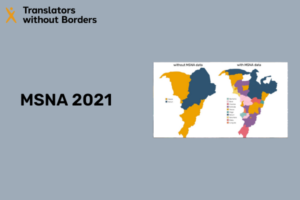
The 2021 multi-sector needs assessments (MSNAs) are a critical opportunity to strengthen the evidence base for effective and accountable humanitarian response plans. Humanitarian donors and responders need data on the languages and communication preferences of affected people as a basis for funding and programming decisions. At a minimum, asking one simple question on language can […]
Five easy steps to integrate language data into humanitarian and development programs
Learn how to best incorporate language data into humanitarian and development programs for more effective community communication.
“How can we contribute if we can’t participate?” The accessibility of humanitarian guidance to local and national organisations
Listen and learn: The link between language and accountability for the future of the Grand Bargain
PSEA recommendations: Language issues for safeguarding
TWB’s research shows that a language sensitive response to Ebola outbreaks could improve understanding and trust in key messages. It will enhance the accessibility of RCCE and AAP mechanisms, including the reporting of SEAH and support to survivors. Learning from the outbreak in DRC, TWB would recommend the actions to take as part of protection […]